
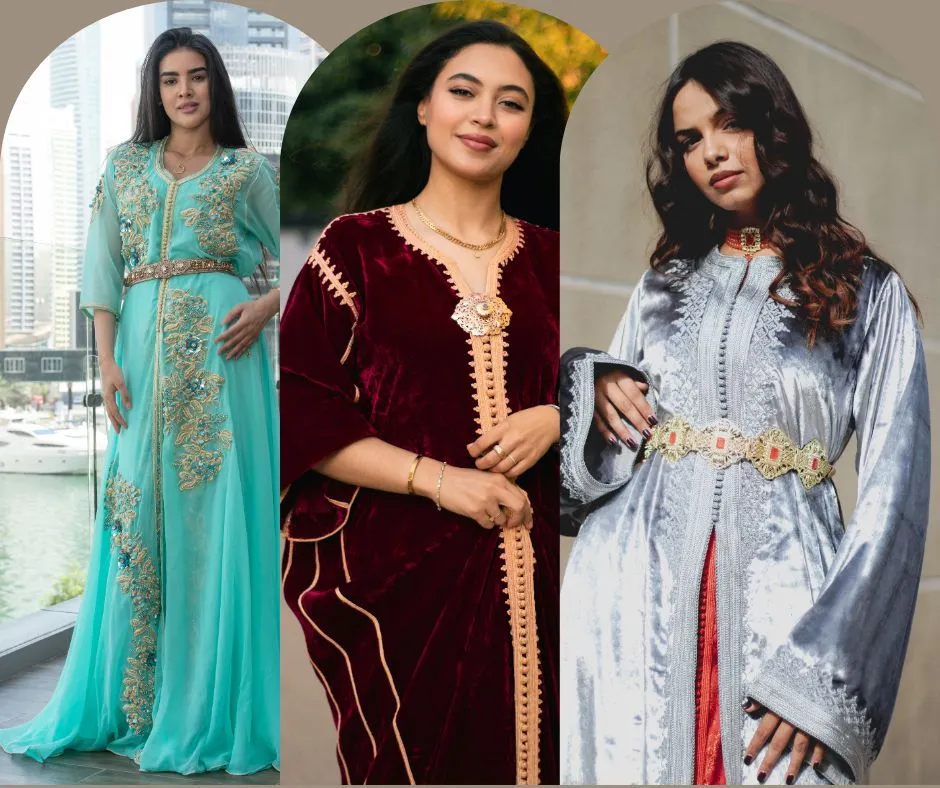
The Stunning Secrets of Moroccan Style: Meaning & Heritage
Have you ever wondered why some garments seem to carry an entire civilization within their threads? When you step into the vibrant world of traditional Moroccan clothing, you aren’t just looking at fashion you are witnessing a living history. From the bustling alleys of the Marrakech medina to the high peaks of the Atlas Mountains, the meaning behind traditional Moroccan clothing is woven into every stitch, button, and fold.
Whether it’s the protective hood of a Djellaba or the regal embroidery of a Caftan, these garments tell a story of resilience, climate, and deep-rooted Maghreb culture. But what do these symbols actually represent? In this guide, we are peeling back the layers of Moroccan silk and wool to discover the “why” behind the wardrobe. We’ll explore how these pieces have evolved from ancient tribal necessities into icons of global Moroccan couture.
Are you ready to discover why a simple robe is actually a masterpiece of engineering and art? Let’s dive into the soul of Moroccan style.
Key Takeaways: What You’ll Learn
If you’re short on time, here are the essential insights we’ll cover in this deep dive:
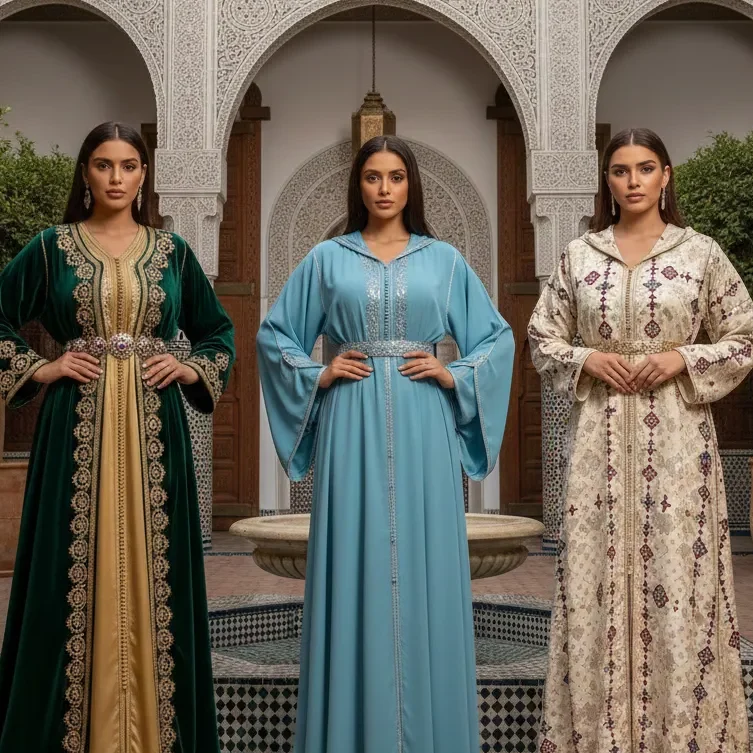
- Symbolic Functionality: Discover how the Qob (hood) of the Djellaba serves as both a weather shield and a practical “pocket.”
- The Art of the M’allem: Understand the role of master craftsmen in creating the Sfifa and Aakad (silk buttons) that define luxury.
- Caftan vs. Takchita: Learn the crucial difference between these two celebratory garments and when it’s appropriate to wear each.
- Climate-Driven Design: See how the Gandoura and Berber attire use natural fibers to master the intense North African heat.
- Modern Evolution: Explore how sustainable slow fashion and Gen Z trends are keeping these ancient silhouettes alive and thriving.
Table of Contents
The Iconic Djellaba: More Than Just a Hooded Robe
Have you ever wandered through the bustling medinas of Marrakech or Fez and noticed a garment that seems to defy time? That is the Djellaba. While it might look like a simple long robe to the untrained eye, it is actually the heartbeat of Moroccan national identity. It’s a piece of clothing that manages to be both humble and regal, serving as a daily companion for millions.
The Symbolic Protection of the Qob (Hood)
The most striking feature of a Djellaba is undoubtedly the Qob the pointed hood. But did you know it’s far more than a stylistic choice? Historically, the hood served a vital dual purpose in the North African climate.
- Practicality: It shields the wearer from the blistering desert sun and the biting winds of the Atlas Mountains.
- The “Pocket” Secret: Traditionally, the Qob was used as a makeshift bag to carry bread, grain, or small personal items.
When you see a Moroccan effortlessly flip their hood up, you aren’t just seeing a fashion statement; you’re witnessing centuries of survival and ingenuity woven into the fabric.
Gender Neutrality and Evolution in Daily Wear
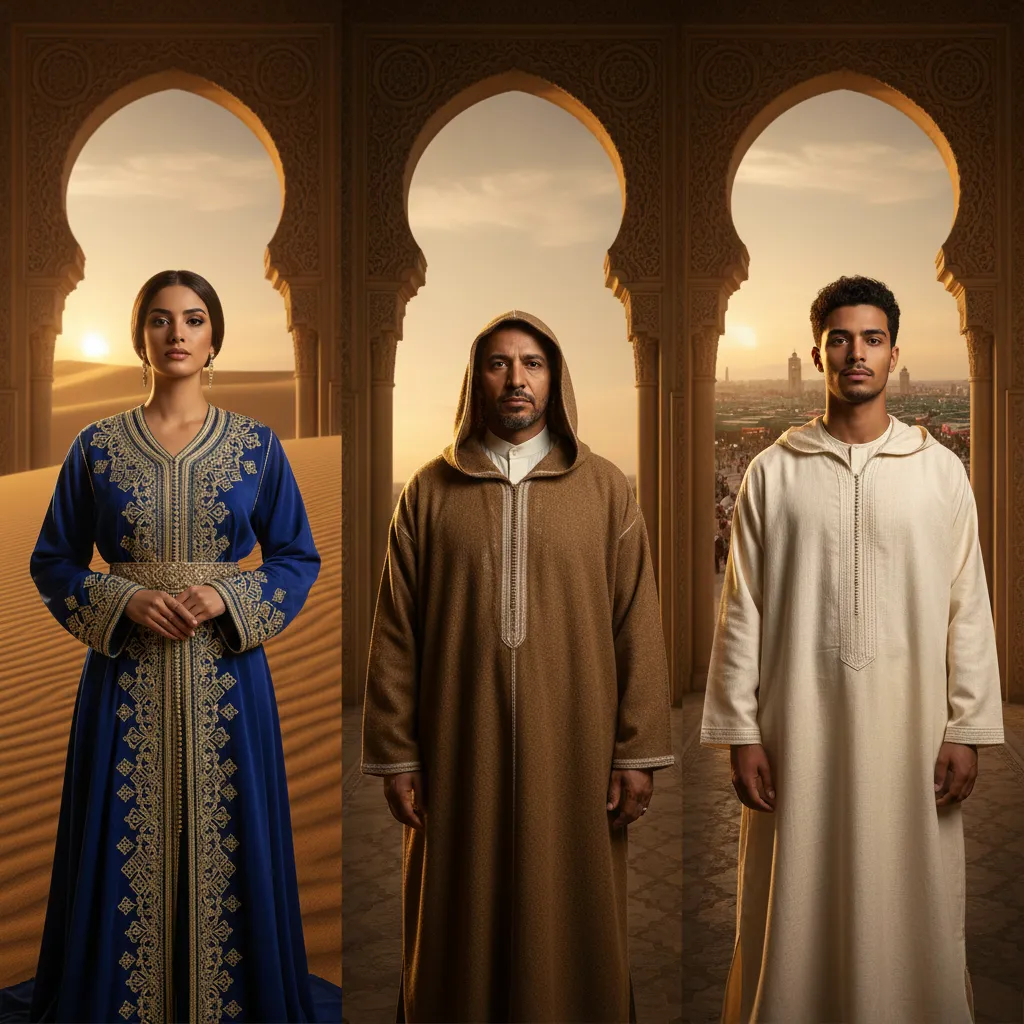
One of the most fascinating Moroccan garment symbolism insights is how the Djellaba bridges the gender gap. While many traditional garments globally are strictly divided, the Djellaba is embraced by both men and women.
Historically, women’s Djellabas were more subdued, but the modern era has seen a literal explosion of color and intricate embroidery. Today, it’s a symbol of equality in the streets—a unifying silhouette that reflects a shared cultural pride. Whether it’s a businessman heading to a meeting or a grandmother visiting the market, the Djellaba is the ultimate “democratized” fashion.
Seasonal Shifts: From Heavy Wool to Light Linen
In Morocco, the landscape dictates the wardrobe. This is where the meaning behind traditional Moroccan clothing becomes a story of geography.
- Winter (The Bziwi Style): In colder months, you’ll find heavy, hand-spun wool Djellabas. These are often coarse to the touch but incredibly insulating, especially in the high-altitude Berber regions.
- Summer (The Sayf Style): As the mercury rises, the wool is swapped for light linen, cotton, or even silk blends.
This seasonal adaptability shows a deep connection to the Moroccan landscape. Instead of fighting the elements, Moroccans have spent generations perfecting a garment that breathes with the earth.
The Djellaba as a Mark of Moroccan National Identity
Why does the Djellaba remain so popular when Western fashion is just a click away? Because in Morocco, wearing a Djellaba is a subtle, beautiful act of resistance against cultural homogenization.
It is the official “uniform” for Friday prayers and religious holidays, signaling a respect for heritage. When a Moroccan puts on a finely tailored Djellaba, they aren’t just getting dressed; they are wrapping themselves in the history of the Maghreb. It’s a visual shorthand for: “I know where I come from.”
The Elegant Caftan: A Masterpiece of Moroccan Artistry
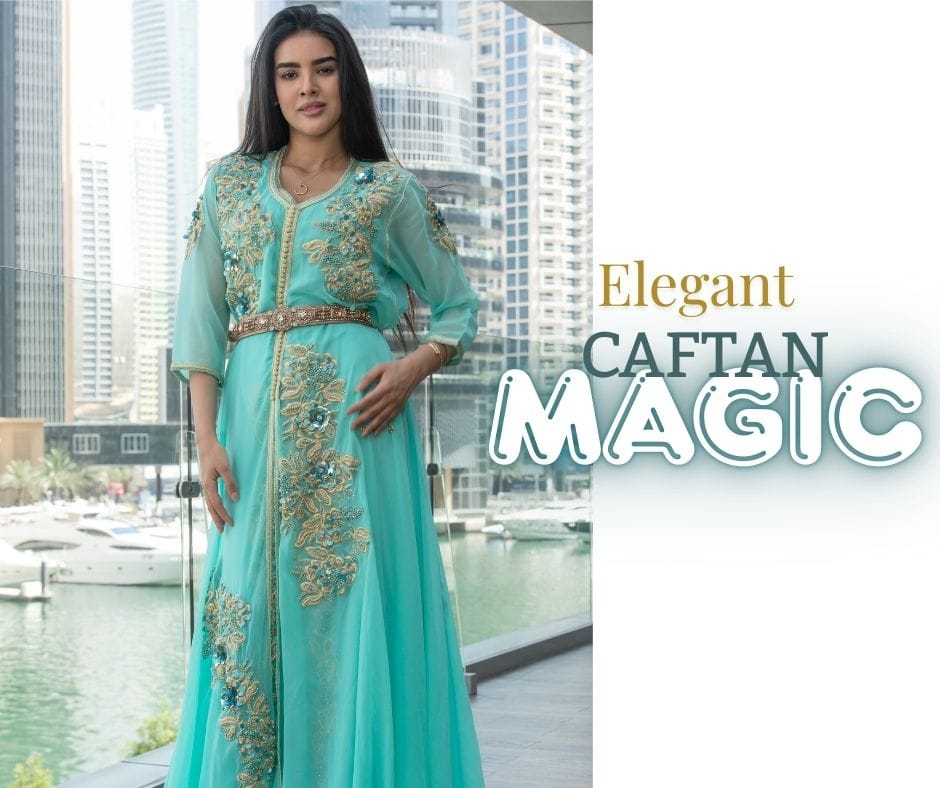
If the Djellaba is the soul of Moroccan daily life, the Moroccan Caftan is undoubtedly its crowning jewel. Have you ever wondered why a single dress can command the same price as a luxury car? It’s because the Caftan isn’t just “clothing” it is a wearable canvas that represents centuries of craftsmanship. When you slip into a Caftan, you aren’t just wearing a garment; you are stepping into a legacy of elegance that has graced royal courts for generations.
Origins and the Influence of Ottoman and Andalusian Styles
To truly understand the Moroccan fashion history behind the Caftan, we have to look north and east. While the Caftan originated in ancient Mesopotamia, it found its true “haute couture” spirit in Morocco.
Unlike the versions found in the Ottoman Empire, which were often reserved for men, the Moroccan Caftan evolved into an exclusively feminine symbol of grace. It absorbed the intricate aesthetics of Andalusian refugees fleeing Spain, blending Moorish geometry with North African flair. This fusion created a silhouette that is globally recognized today as the pinnacle of traditional celebratory attire.
The M’allem’s Touch: Understanding Sfifa and Aakad (Buttons)
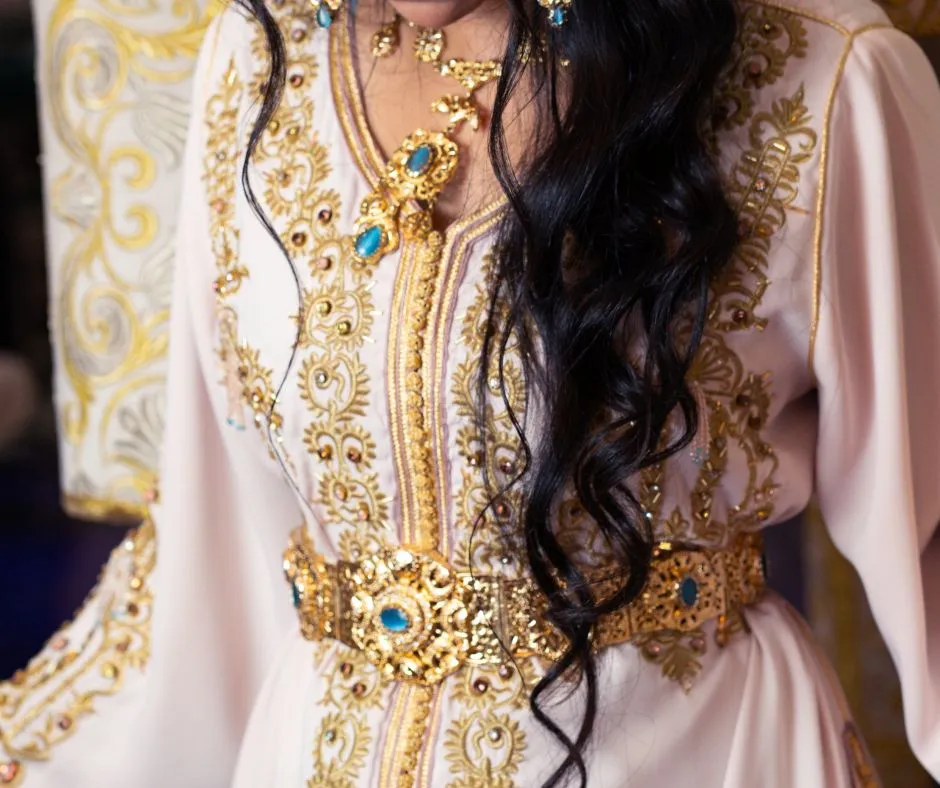
Have you ever looked closely at the trim of a high-end Caftan? Those aren’t machine-made decorations. Every loop and button is the result of thousands of hours of manual labor by a M’allem (master artisan).
The “Sfifa” is the braided silk trim that borders the edges, while the “Aakad” are the tiny, handmade silk buttons that run down the front. A traditional Caftan can have over a hundred of these buttons, each one hand-knotted. This level of detail is why the Caftan remains a centerpiece of Moroccan couture.
The Distinction Between the Caftan and the Two-Piece Takchita
One of the most common questions I get is: “Is that a Caftan or a Takchita?” While the terms are often used interchangeably, there is a key difference:
- The Caftan: A single-layer, luxurious robe, typically cinched with a wide, ornate belt (Mdamma).
- The Takchita: A two-piece evolution. It consists of a base layer (Tahtia) and a sheer, heavily embroidered top layer (Fouqia).
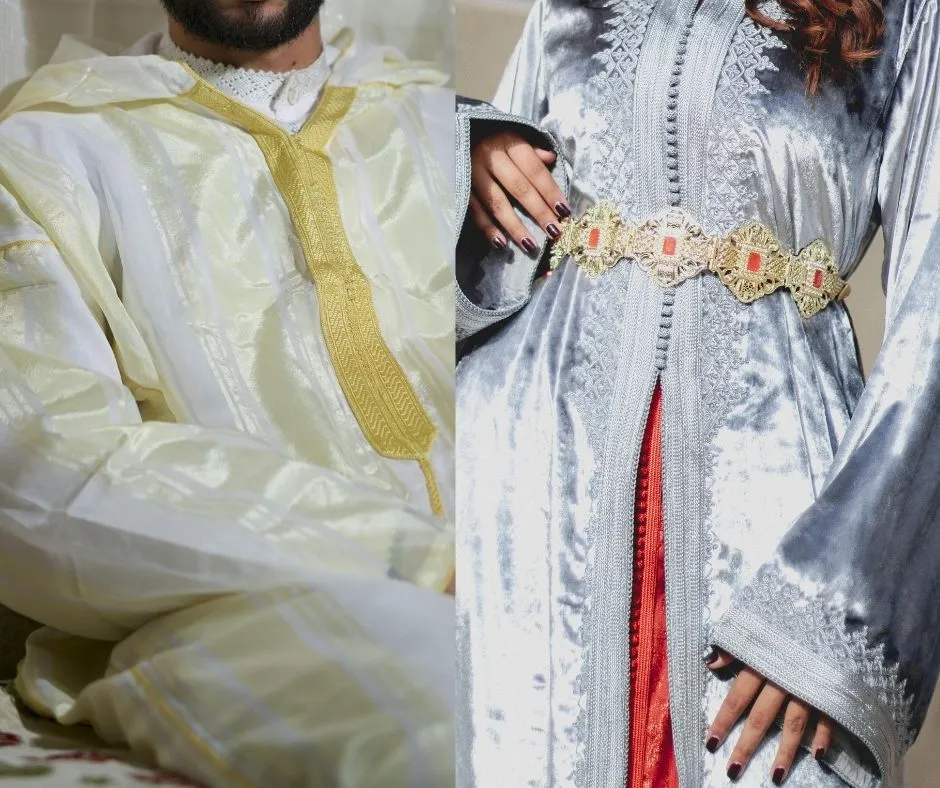
The Takchita is what you’ll usually see at a Moroccan wedding, as it allows for more volume, drama, and a display of multiple layers of silk and lace.
Symbolic Colors for Weddings and Formal Ceremonies
Color in Morocco is never accidental. When choosing a Caftan for a ceremony, the palette speaks volumes:
- White: Symbolizes purity and is the primary color for a bride’s first entrance.
- Green: Represents paradise and prosperity; often worn for the Henna ceremony.
- Red & Gold: Signify power, passion, and wealth common for the “Grand Entrance.”
The “Recipe” for an Authentic Moroccan Caftan
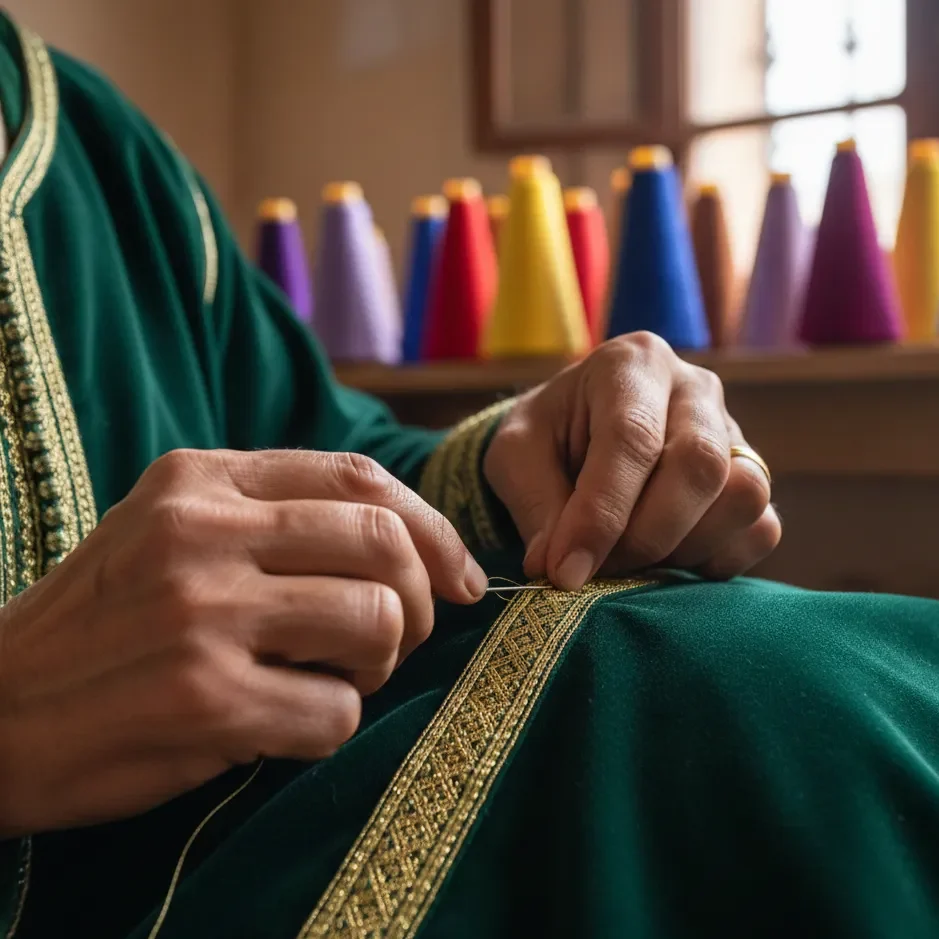
Creating a museum-quality Caftan requires specific “ingredients” and artisans. Here is what goes into a single masterpiece:
| Component | Quantity | Description/Role |
| Luxury Fabric | 3.5 – 5 Meters | Typically Silk, Velvet, or Brocade (often imported from Lyon or Italy). |
| Silk Thread (Sabra) | 500+ Meters | Used by the M’allem to create the Sfifa and Aakad buttons. |
| Handmade Buttons (Aakad) | 100 – 150 Units | Each button is individually knotted by hand to fasten the front. |
| Master Artisans | 3 – 5 People | Includes the tailor, the embroiderer, and the belt maker. |
| Crafting Time | 2 – 6 Months | The time required for a fully hand-stitched, bespoke piece. |
The Breezy Gandoura: Comfort Meets Cultural Pride
If the Caftan is the queen of the Moroccan wardrobe, then the Gandoura is surely the king of everyday ease. Have you ever wondered how people stay so effortlessly cool while wandering through the sun-baked streets of the Sahara? The secret lies in the Gandoura. While it might look like a simple short-sleeved tunic to a passerby, it represents a masterful balance between functional design and deep-rooted Maghreb culture.
Functional Design for the North African Climate
Why do we love the Gandoura? It’s all about the “breathability” factor. Unlike more formal attire, the Gandoura is designed with a wide, airy silhouette and short sleeves (or even sleeveless cuts) to maximize airflow.
- Heat Management: The loose fit prevents the fabric from clinging to the skin, which is vital during those 40°C Moroccan afternoons.
- Ease of Movement: Whether you’re sitting down for a three-course tajine or performing daily prayers, the Gandoura offers unparalleled freedom.
It’s essentially the original “loungewear,” perfected over centuries to handle the harsh North African climate without sacrificing a shred of dignity.
Variations Across Berber and Arab Regions
One of the most rewarding parts of exploring traditional Moroccan clothing is spotting the regional “dialects” of the Gandoura. You’ll notice that a Gandoura in the northern Rif mountains looks quite different from one in the southern Draa Valley.
- Berber Influence: Often features heavier cotton and geometric, tribal-inspired embroidery around the neckline.
- Arab Influence: Typically uses lighter fabrics like “Mlifa” and leans toward more intricate, floral needlework.
- The Sahrawi Deraa: In the deep south, this evolved into the wide, blue “Daraa,” which is technically a cousin of the Gandoura designed to whip through desert winds.
Minimalist Embroidery: Elegance in Simplicity
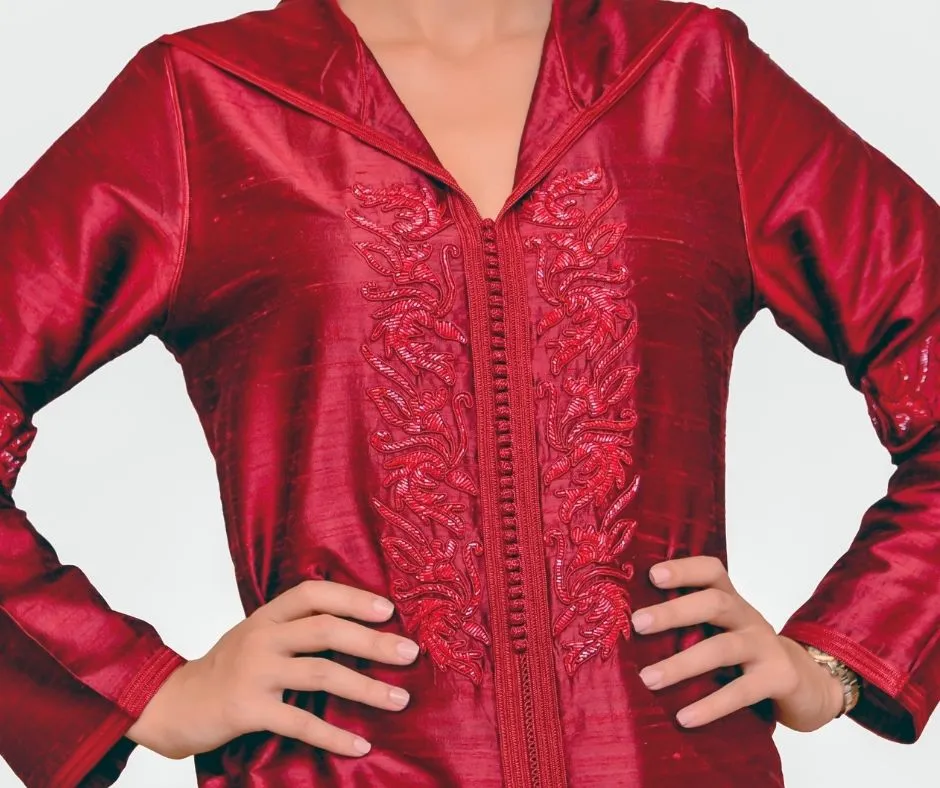
While the Caftan screams “look at me,” the Gandoura whispers. Its beauty lies in minimalist embroidery. You won’t find heavy beads or five-pound belts here. Instead, you’ll see delicate “Randa” or “Sfifa” stitching around the collar and sleeves.
This understated elegance is exactly why it has transitioned so successfully into the modern world. It’s the perfect example of how Moroccan garment symbolism doesn’t always have to be flashy to be meaningful sometimes, the meaning is found in the quiet pride of a well-placed stitch.
The Modern Shift to Loungewear and Global Fashion
In recent years, the Gandoura has stepped off the Moroccan streets and onto the global stage. We are seeing a massive shift where Gen Z and international designers are reimagining the Gandoura as a unisex summer staple.
It has become the “go-to” for high-end resorts and ethical fashion brands because it hits that sweet spot of sustainable slow fashion. It’s a piece that doesn’t go out of style, doesn’t require a zipper, and lasts for decades.
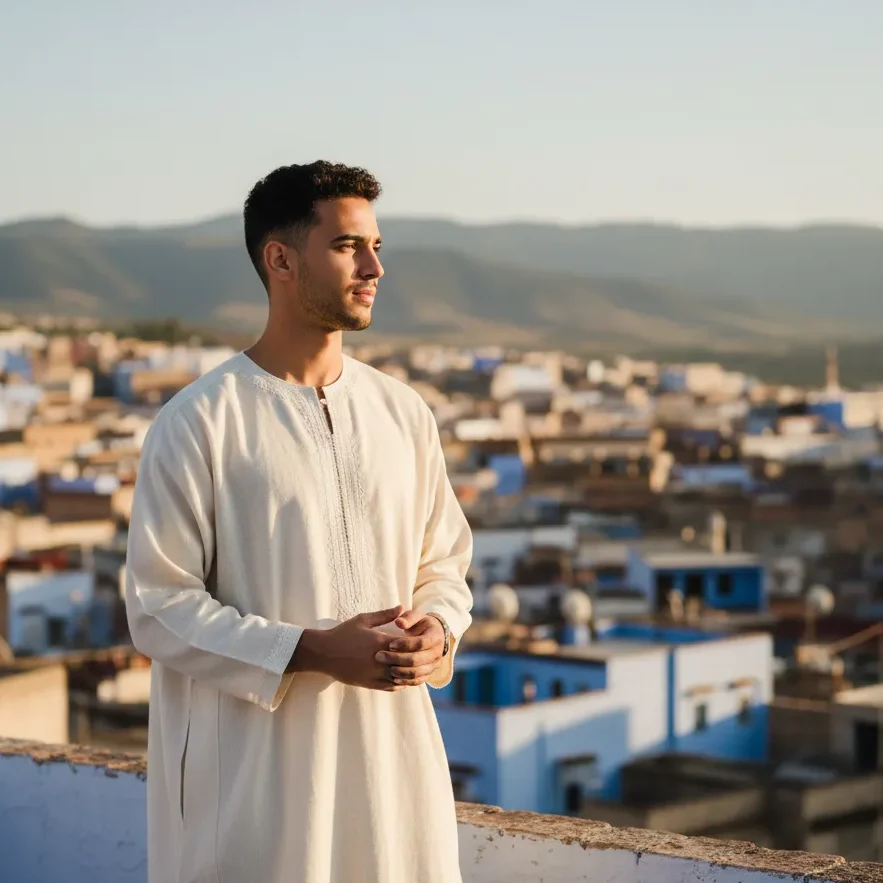
Watch: The Making of a Traditional Gandoura
To truly appreciate the effort that goes into the “simple” embroidery of these robes, check out this look at Moroccan craftsmanship:
Materials and Motifs: The Hidden Language of Fabric
Have you ever run your fingers over a piece of Moroccan silk and felt like the fabric was telling you a story? You aren’t imagining it. In the world of traditional Moroccan clothing, the choice of thread and the pattern of a stitch are never accidental. They are a coded language, a way for the wearer to signal their roots, their status, and even their dreams without saying a single word.
Natural Fibers: The Connection to the Moroccan Landscape
The soul of any Djellaba or Caftan begins with the earth. Historically, Moroccan artisans didn’t look to global supply chains; they looked to their backyard. This deep connection to the Moroccan landscape is why the textures of these garments feel so “right” in their environment.
- Sabra (Cactus Silk): Derived from the Saharan aloe vera cactus, this vegan silk is prized for its high sheen and durability.
- Mlifa (Fine Wool): Sourced from high-atlas sheep, this wool is combed and spun into a fabric so soft it rivals cashmere.
- Linen and Cotton: Essential for the coastal humidity of Casablanca and Tangier, these fibers allow the skin to breathe.
Hand-Stitched Patterns and Their Tribal Meanings
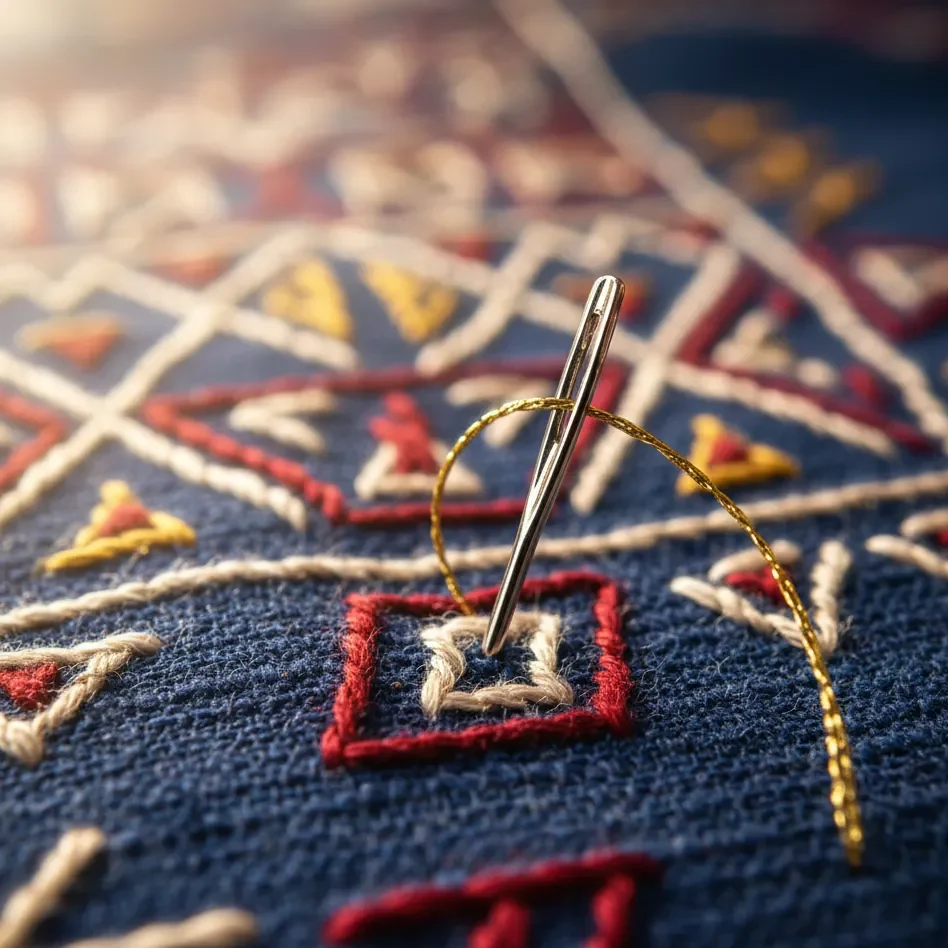
If you look closely at the embroidery on a Berber Gandoura, you’ll notice sharp, geometric zig-zags and diamonds. These aren’t just pretty shapes; they are hand-stitched patterns with ancient roots.
For many tribal communities, the “diamond” shape represents the eye, intended to ward off the “evil eye” and protect the wearer. The “wheat ear” pattern signifies fertility and abundance. Every time a needle passes through the fabric, the artisan is effectively sewing a prayer or a blessing into the garment.
Why Gold and Silver Thread Dominate Festive Attire
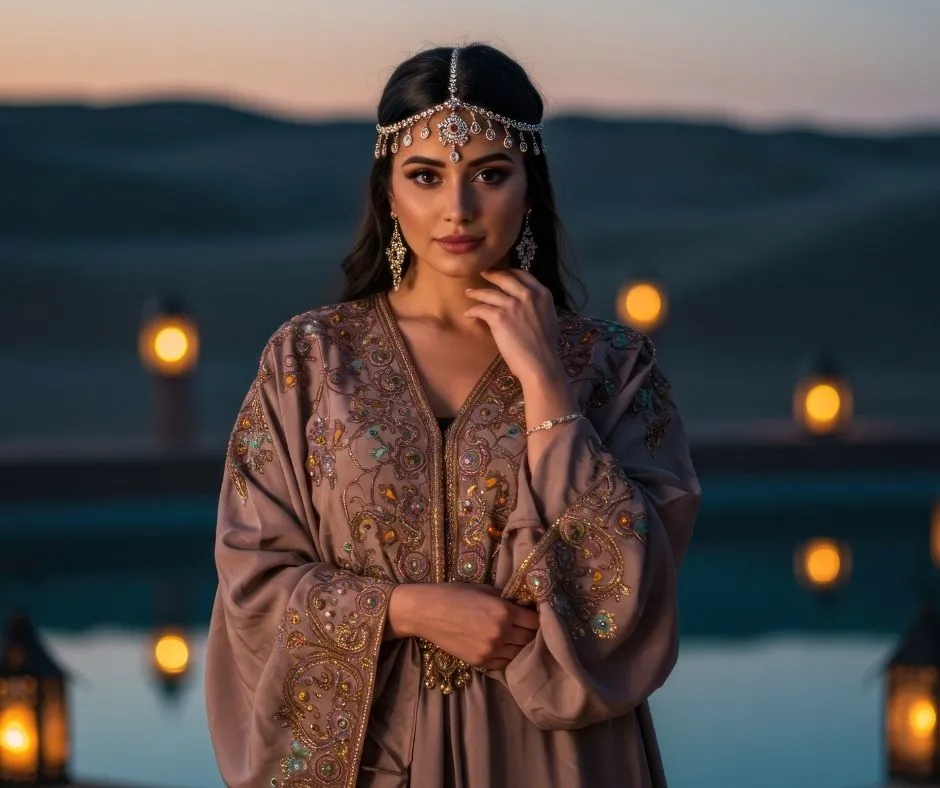
When it comes to traditional celebratory attire, “more is more” is the golden rule literally. The use of gold (Skalli) and silver thread is what transforms a simple dress into a royal statement.
- Status and Prestige: Historically, real gold wire was used to show the wealth of a family during wedding negotiations.
- Reflecting the Light: In candlelit Moroccan riads, the metallic threads catch the light, making the wearer appear to glow from within.
- Durability: Unlike cheap synthetic dyes, high-quality metallic threads don’t tarnish easily, allowing these garments to be passed down as family heirlooms for decades.
The Role of Vegetable Dyes in Traditional Color Palettes
Before synthetic pigments arrived, Morocco was a world of natural hues. The vibrant reds came from poppy petals or madder root; the deep indigos from desert shrubs; and the iconic yellows from saffron and pomegranate skins. These vegetable dyes create a “living” color a palette that ages beautifully and carries the scent of the bazaar.
“In Morocco, we don’t just wear our history; we weave it into every thread. A garment without a story is just a piece of cloth, but a garment with a motif is a memory.” A Local M’allem (Master Artisan) from the Fes Medina
Preserving the Soul: Moroccan Fashion in the Modern Era
Have you ever wondered if traditional clothes eventually become “museum pieces”? In many parts of the world, that is exactly what happens. But in Morocco, the story is different. We aren’t just looking back at history; we are watching it evolve in real-time. The meaning behind traditional Moroccan clothing is currently being rewritten by a new generation that refuses to choose between their heritage and their modern, fast-paced lives.
How Gen Z is Reimagining Traditional Silhouettes
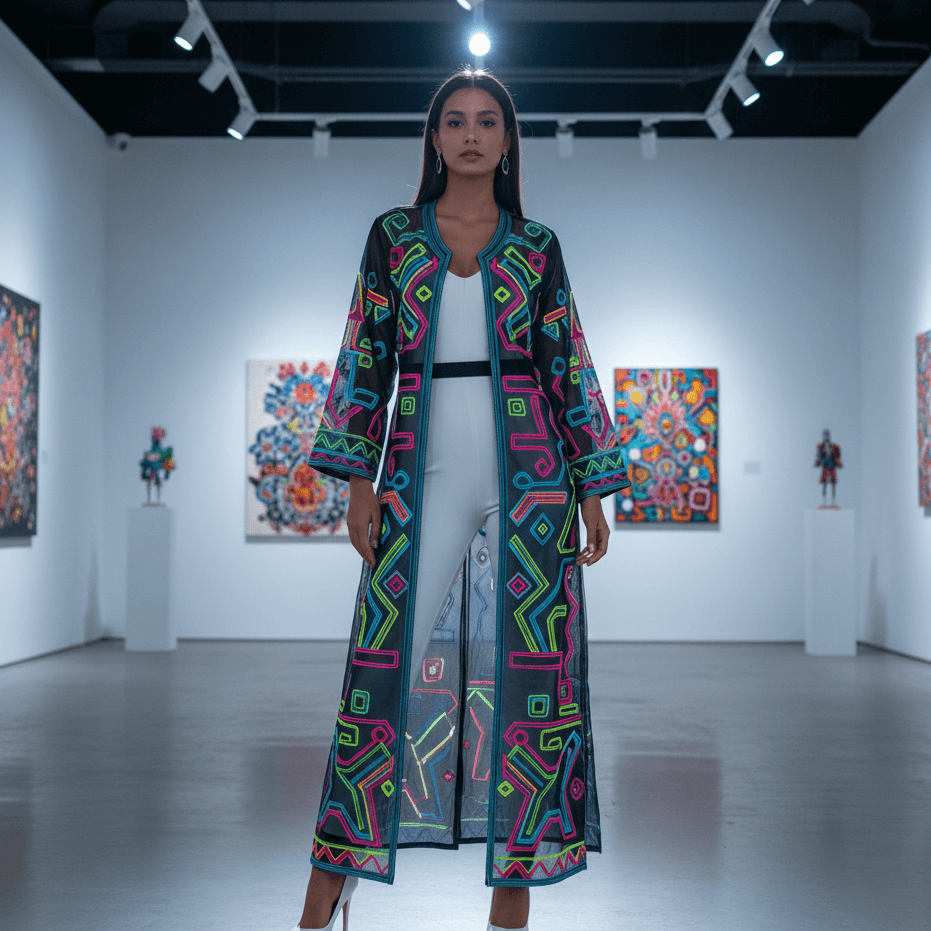
If you walk through the modern districts of Casablanca or Rabat today, you’ll see something remarkable. Young Moroccans are pairing cropped Djellabas with sneakers or wearing a sleeveless Gandoura over jeans.
This isn’t about discarding tradition; it’s about making it wearable for the 21st century. By reimagining traditional silhouettes, Gen Z is ensuring that these garments remain relevant. They are stripping away the “heaviness” of formal wear and turning these pieces into versatile, everyday statements. It’s a bold way of saying, “This culture belongs to me, and I’ll wear it my way.”
The Impact of Global Luxury Brands on Moroccan Artisans
It’s no secret that the international fashion world has a crush on Morocco. From Saint Laurent to Dior, the global stage has frequently borrowed (and sometimes “borrowed” too much) from Moroccan aesthetics.
- Visibility: These global nods have put a spotlight on the M’allem (master craftsmen), bringing international eyes to the complexity of the Sfifa and Takchita.
- The Ethics of Appropriation: However, this has also sparked a vital conversation about credit. It has pushed Moroccan designers to reclaim their narrative, ensuring that the wealth and recognition of Moroccan couture stay within the local communities that created them.
Sustainable Slow Fashion: The Moroccan Heritage Model
In an age of “disposable” fast fashion, the Moroccan way of dressing is a breath of fresh air. This is the ultimate sustainable slow fashion model. Think about it: a high-quality Caftan or Djellaba is made to last a lifetime.
- Longevity: These pieces are often passed down from mothers to daughters, carrying the stories of past celebrations.
- Zero Waste: Because they are mostly made-to-order by local tailors, there is no mass overproduction.
- Biodegradable: When you use natural fibers like wool, silk, and cotton, you are respecting the earth just as much as the tradition.
Why Wearing Traditional Garments is a Revolutionary Act
In a world that is becoming increasingly homogenized, choosing to wear a traditional garment is a quiet, powerful revolution. It is a refusal to let local identity be swallowed by global trends.
When you see a Moroccan designer showcase a modern Takchita on a runway in Paris or Milan, they are doing more than showing a dress. They are preserving the soul of a nation. They are proving that Moroccan national identity isn’t a static thing from the past it’s a living, breathing, and incredibly stylish force for the future.
Final Thoughts: Wearing the Heart of Morocco
So, what is the true meaning behind traditional Moroccan clothing? As we’ve journeyed from the protective hood of the Djellaba to the regal gold threads of the Caftan, one thing becomes crystal clear: these garments are not merely fabric. They are a vibrant, living bridge between a glorious past and a bold future.
Whether you are a traveler looking to respect local customs or a fashion enthusiast inspired by Moroccan couture, wearing these pieces is an invitation to slow down. It’s a call to appreciate the “M’allem” who spent weeks on a single seam and to honor a culture that refuses to let its soul be lost to the cycle of fast fashion. Next time you see the graceful silhouette of a Gandoura catching the Mediterranean breeze, remember that you aren’t just looking at a style you’re looking at a masterpiece of national identity.
Common Questions About Moroccan Attire (Q&A)
To help you navigate your next cultural encounter or shopping trip, I’ve rounded up some of the most frequent questions regarding Moroccan fashion history and etiquette.
- Can non-Moroccans wear a Djellaba or Caftan? Absolutely! Moroccans are incredibly proud of their heritage and generally feel honored when visitors appreciate their craftsmanship. Just remember to wear them with respect—save the ornate Caftans for formal events and the Djellaba for modest daily outings.
- What is the main difference between a Caftan and a Takchita? Think of the Caftan as the elegant “base” (a single layer), while the Takchita is the “double-decker” version consisting of two layers. The Takchita is almost exclusively reserved for grand celebrations like weddings.
- How can I tell if a garment is truly handmade? Look at the Aakad (the small buttons). If they are slightly irregular and hand-knotted, they are authentic. Machine-made versions often look too perfect and “flat.”
- Is the Gandoura unisex? While traditionally there are distinct cuts for men and women, modern fashion has made the Gandoura a versatile, unisex staple loved for its breezy comfort in the North African climate.